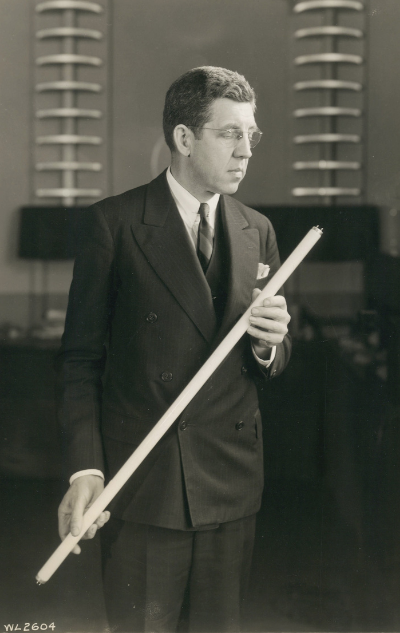
 As the United States approaches the 250th anniversary of its founding, it is fitting to reflect on individuals whose ingenuity helped illuminate the nation—sometimes quite literally. Among them was Samuel Hibben, a pioneering lighting engineer whose work shaped how Americans experience some of the country’s most recognizable landmarks. Through a career spanning more than four decades, Hibben combined scientific innovation with artistic vision, leaving a legacy that continues to shine across the American landscape.
Born June 6, 1888, in Hillsboro, Ohio, Hibben showed an early aptitude for science and engineering. He attended the Case School of Applied Science (now Case Western Reserve University), graduating in 1910 with a degree in electrical engineering. While at Case, he worked in the physics laboratory of Nobel Prize–winning scientist Albert A. Michelson, which sparked Hibben’s fascination with the science of light.
During his undergraduate years, Hibben became a member of Sigma Nu’s Delta Alpha Chapter, chartered only a few years earlier. Even then, his character left a strong impression on those around him. In a 1926 profile published in The Delta, chapter brother Lawrence Hopkins recalled their friendship and Hibben’s influence within the young chapter:
“Both Sigma Nu and I were very fortunate to ‘team up’ with Sam early in his career, when he was an undergraduate at Case, and both of us have profited by the association ever since. Sigma Nu gained a staunch and loyal supporter, while I gained a fraternity brother and chum of sterling worth.”
Hopkins remembered Hibben not only for his intellect, but also for his generosity and character. As a roommate and close friend, Hopkins wrote that Hibben possessed “a broad-minded adherence to high principles and sound logic” that made him invaluable to the chapter. He also recalled Hibben’s generosity, noting, “the proverbial shirt from his back was yours if you needed it.”
 Early Innovations in Light
After graduating from Case, Hibben began his professional career with the MacBeth-Evans Glass Company in Pittsburgh, where he designed optical glass components. Among his early accomplishments was the development of a catadioptric lens system for lighthouse illumination—the first of its kind produced in the United States. Installed in multiple coastal lighthouses, the system significantly improved maritime navigation safety.
In 1916, Hibben joined the Westinghouse Electric Company, beginning a long and influential career with the firm. His work was temporarily interrupted by service in the U.S. Army Corps of Engineers during World War I, where he applied his technical expertise to national defense. There, he designed anti-aircraft searchlights and developed an acoustic system used to locate enemy artillery positions.
Following the war, Hibben returned to Westinghouse, where his creativity and technical insight quickly distinguished him as a leader in the field of illumination. By 1933, he had been appointed Director of Applied Lighting for the company’s Lamp Division in Bloomfield, New Jersey. In that role, he was given remarkable freedom to explore new lighting technologies and applications—an opportunity that allowed him to reshape the visual landscape of modern America.
Lighting the American Experience
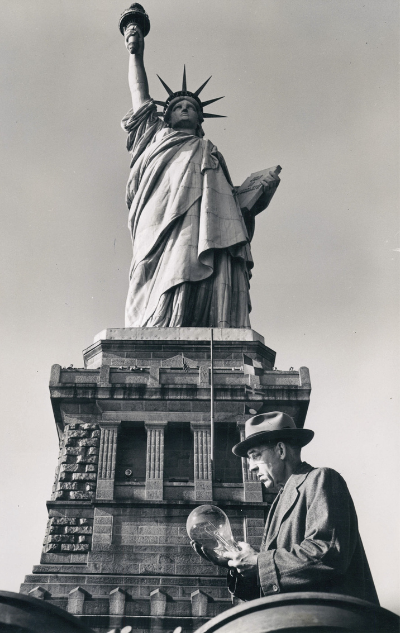
Hibben’s designs helped illuminate some of the nation’s most iconic landmarks. His work contributed to the lighting of the Holland Tunnel, the Statue of Liberty, and the Washington Monument, among many others. During World War II, he was tasked with redesigning the illumination of the Statue of Liberty’s torch, which had been darkened after the United States entered the war. Hibben devised a powerful lighting system using incandescent and mercury-vapor lamps that created the illusion of a glowing flame. The torch was relit on V-E Day, May 8, 1945, symbolically restoring the beacon of liberty at the moment of Allied victory.
His innovations extended far beyond landmark lighting. Hibben contributed to the development of improved highway and street lighting systems, airport runway illumination, underwater lighting technologies, and ultraviolet “black light” applications used in sterile environments such as hospitals and food-processing facilities. Through these innovations, he helped shape the practical infrastructure of modern lighting.
Hibben also played an important role in lighting major exhibitions and world’s fairs—events that celebrated American progress and national milestones. His work contributed to displays at the Philadelphia Sesquicentennial Exposition in 1926, commemorating the 150th anniversary of the Declaration of Independence. He later participated in additional international expositions and the 1939 New York World’s Fair, where fluorescent lighting was introduced on a large scale. These dramatic displays helped capture the imagination of the public and demonstrated the artistic potential of electric illumination.
Educator, Innovator, Brother
Beyond engineering, Hibben devoted considerable energy to education and professional leadership. A lifelong member of the Illuminating Engineering Society, he lectured widely and wrote articles explaining the science and possibilities of lighting to both professional audiences and the general public. His demonstrations often captivated audiences with dramatic lighting effects that illustrated the emerging capabilities of electric illumination.
His contributions earned numerous honors, including the Westinghouse Order of Merit, an honorary doctorate from Case Institute, and the Illuminating Engineering Society Gold Medal. Decades after his death in 1972, the Society recognized him in 2006 as one of the eight most distinguished pioneers in the history of lighting design.
As the United States commemorates 250 years of independence, the illuminated monuments, tunnels, caverns, and landmarks that Americans enjoy today stand as quiet reminders of Hibben’s work. Through science, creativity, and service, this Sigma Nu engineer helped quite literally light the nation’s path forward.
A Connection to the Shenandoah Valley
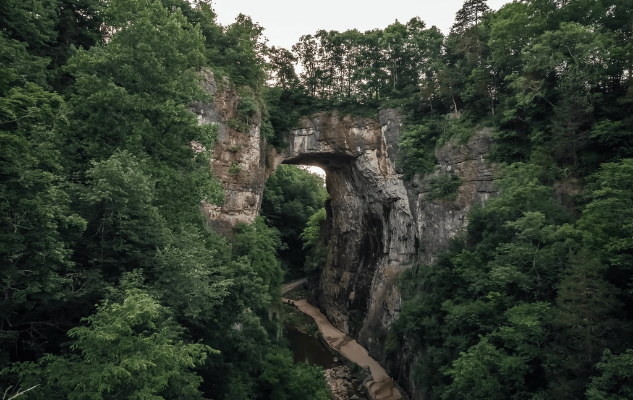
Hibben was interested in how light could reveal the beauty of the natural world. In 1927, he developed a dramatic system of concealed floodlights for Natural Bridge, a geological formation located just a short drive south of Sigma Nu Fraternity Headquarters in Lexington, Virginia. He bathed the massive stone arch in changing colors, highlighting geological features invisible during the day. The success of the installation inspired similar lighting designs for Endless Caverns in Virginia, Carlsbad Caverns in New Mexico, and Crystal Caves in Bermuda.